It is open until October 18th, 2026, the “Misterios de la materia” exhibition at the National Archaeological Museum – MAN in Madrid, Spain. The project is organised in collaboration with the Spanish National Research Council (CSIC) and its National Centre for Metallurgical Research (CENIM-CSIC), and in cooperation with the Spanish Cultural Heritage Institute (IPCE).
The exhibition offers a reflection on an interdisciplinary scientific field that makes a unique contribution to the study, interpretation, and preservation of its important holdings: heritage science. It is organised in six thematic sections, each focused on a specific archaeological research question to which heritage science has helped provide answers. When was an object created? In what period did a person live? What were these individuals like, and how did they interact with plants and animals? What methods did they use to produce objects? What techniques allow us to obtain new data from archaeological artefacts and remains? How are they conserved and restored? And how do we convey their image and meaning?
It features more than 260 objects from various cultural and chronological contexts within the MAN collections, as well as materials from its Archive and Library. It includes items from key archaeological sites in Spanish and European history, such as the Cueva de los Murciélagos and Los Millares, as well as significant assemblages like those from the Huelva Estuary, Recópolis, and Guarrazar, among others. In addition, two complementary rooms present the results of comprehensive studies carried out on two unique objects: the sculpture of Saint Toribio, a remnant of the now-vanished Convent of Santo Domingo el Real in Madrid, and the Egyptian coffin of Pairusejer from Luxor. The exhibition is complemented by a special route through the permanent collection, which will include, among other pieces, the Lady of Elche and the iconic sphinxes that welcome visitors outside the museum building, as well as large-scale medieval paintings.
On Thursday, 11th June, the E-RIHS Director General, Vania Virgili, attended a workshop organised in the frame of the MAN exhibition activities. In her presentation, it was highlighted how the studies presented in “Misterios de la materia” precisely reflect the principles that E-RIHS coordinates and makes available at the European scale. The programme also included a panel on the future of heritage science, with the participation of Julio del Hoyo-Meléndez from the National Museum in Kraków, Chair of the E-RIHS Scientific and Ethics Advisory Board (SEAB).
Many laboratories and institutions across Spain took part in the studies the exhibit is based on, applying materials science and analytical characterisation to the museum’s collections. Although carried out in different contexts, these are also E-RIHS driving principles: share a transdisciplinary approach, a preference for non-invasive methods, and the combination of imaging, material analysis, and dating performed by complementary teams.
The Egyptian coffin of Amenemhat illustrates this directly. Within the PEMAN (Policromías Egipcias Museo Arqueológico Nacional) project, access was requested through the MOLAB platform under IPERION CH, one of the European heritage science projects that led to the foundation of E-RIHS ERIC. Italian and French researchers travelled to the MAN with portable, non-destructive equipment and, without taking a single sample, examined the polychromy by measuring how its materials respond to different forms of light. This type of analysis makes it possible to identify the pigments used and how they were applied, to distinguish original materials from later additions, and to detect traces of earlier interventions that are invisible to the naked eye. In this case, the results confirmed the palette of the ancient Egyptians, including Egyptian blue and green, and that the coffin had been reused in antiquity, with the name of its first owner replaced by that of a later one.
Several of the institutions whose work is shown in the exhibition and the associated itinerary are themselves part of E-RIHS. The Spanish National Research Council (Consejo Superior de Investigaciones Científicas, CSIC) takes part in the infrastructure through several of its institutes: among them the National Centre for Metallurgical Research (CENIM-CSIC), the home institute of Emilio Cano, who curated the exhibition together with Nayra García-Patrón Santos, Head of Conservation at the MAN, in a close museum-science collaboration. The Spanish Cultural Heritage Institute (Instituto del Patrimonio Cultural de España, IPCE) is also a member. Both are represented in the exhibition through carried out analyses on a number of the objects on display. CENIM-CSIC offers a particularly clear example: the method it developed to study corrosion in situ on the MAN’s monumental sphinxes at the main entrance, is today one of the services available through the E-RIHS catalogue, and therefore accessible to the wider European community.
For an exhibition devoted to the mysteries of matter, E-RIHS represents the European framework that turns individual analyses into shared, sustainable knowledge, ensuring that the science behind these collections continues to grow and to serve the heritage it studies.
The occasion was also an opportunity for the Director General to visit the IPCE, hosted by María Martín Gil, Head of its Research and Training Area and the IPCE’s contact point for E-RIHS. The visit included some of the institute’s restoration and analysis laboratories – among them those for paper and graphic documents and for polychrome wooden sculpture – as well as its specialised library, which the IPCE makes available within E-RIHS through the ARCHLAB platform.
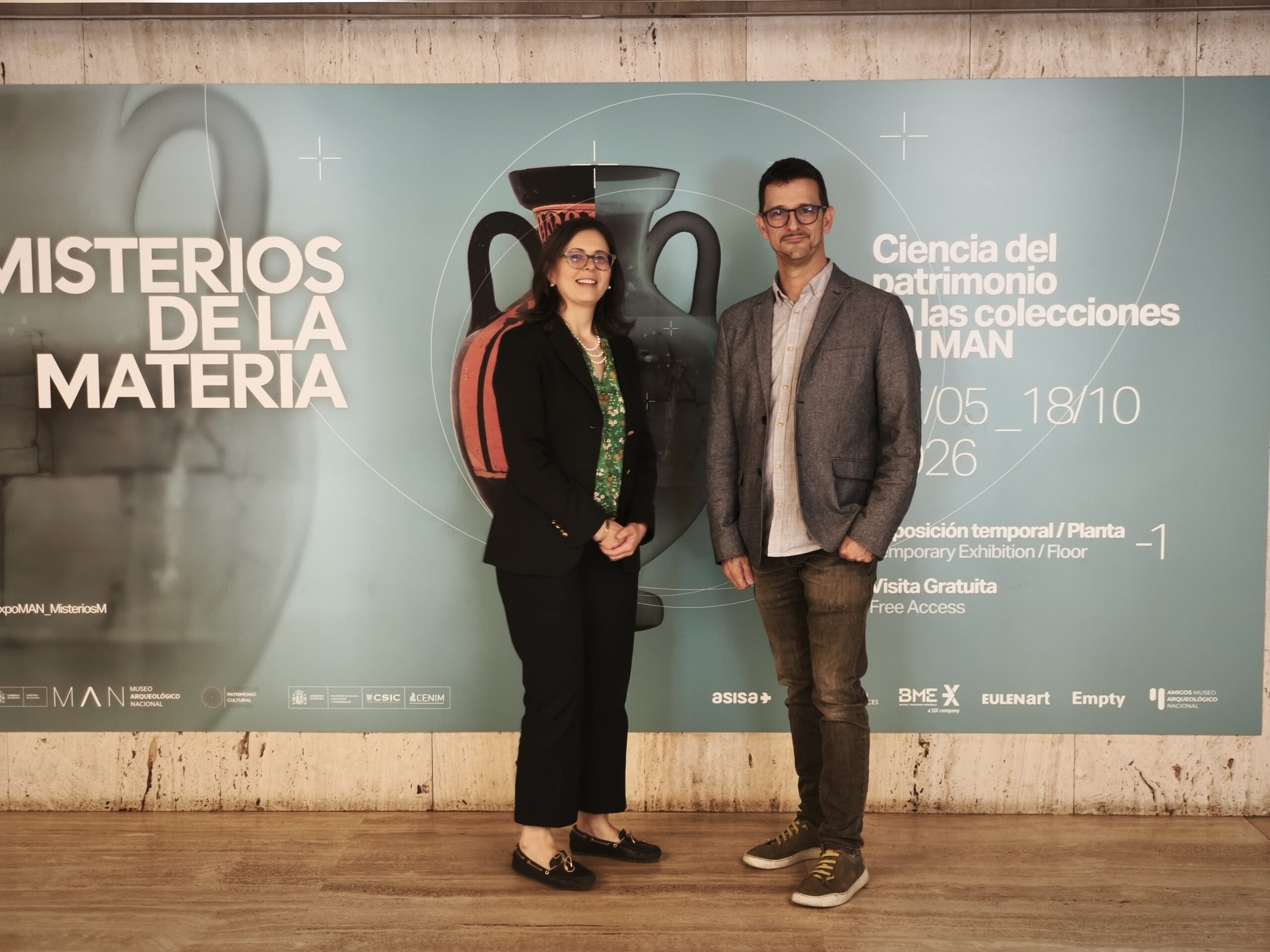
Vania Virgili and Emilio Cano in front of the “Misterios de la materia” exhibition main poster. Credits: Marc Gener
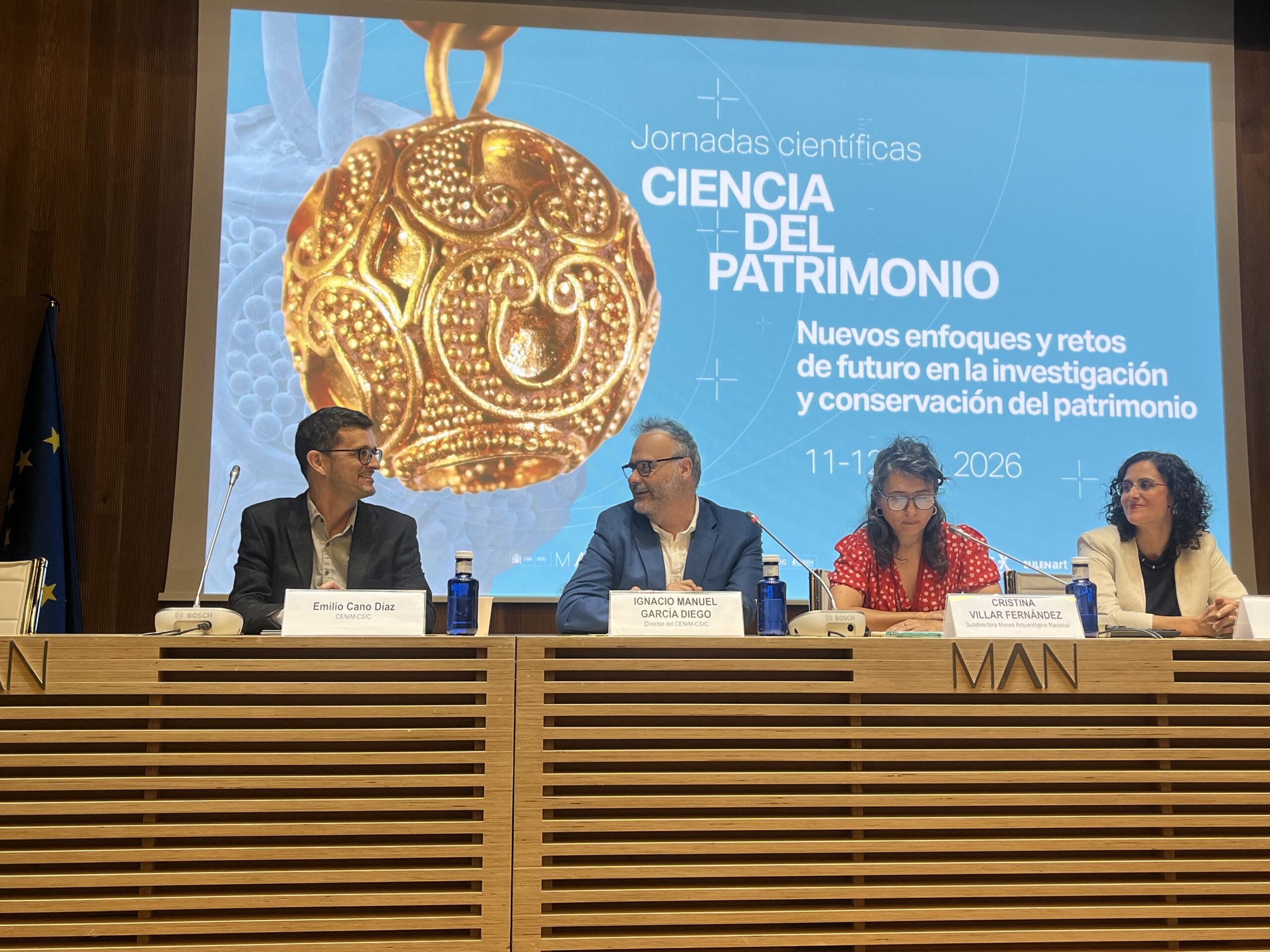
Opening of the “Ciencia del Patrimonio” scientific conference (MAN, Madrid, 11–12 June 2026). From left: Emilio Cano Díaz, exhibition curator and E-RIHS Spanish National Node Coordinator (CENIM-CSIC); Ignacio Manuel García Diego, Director of CENIM-CSIC; Cristina Villar Fernández, Deputy Director of the National Archaeological Museum; and Nayra García-Patrón Santos, exhibition curator and Head of Conservation at the MAN. Credits: Vania Virgili
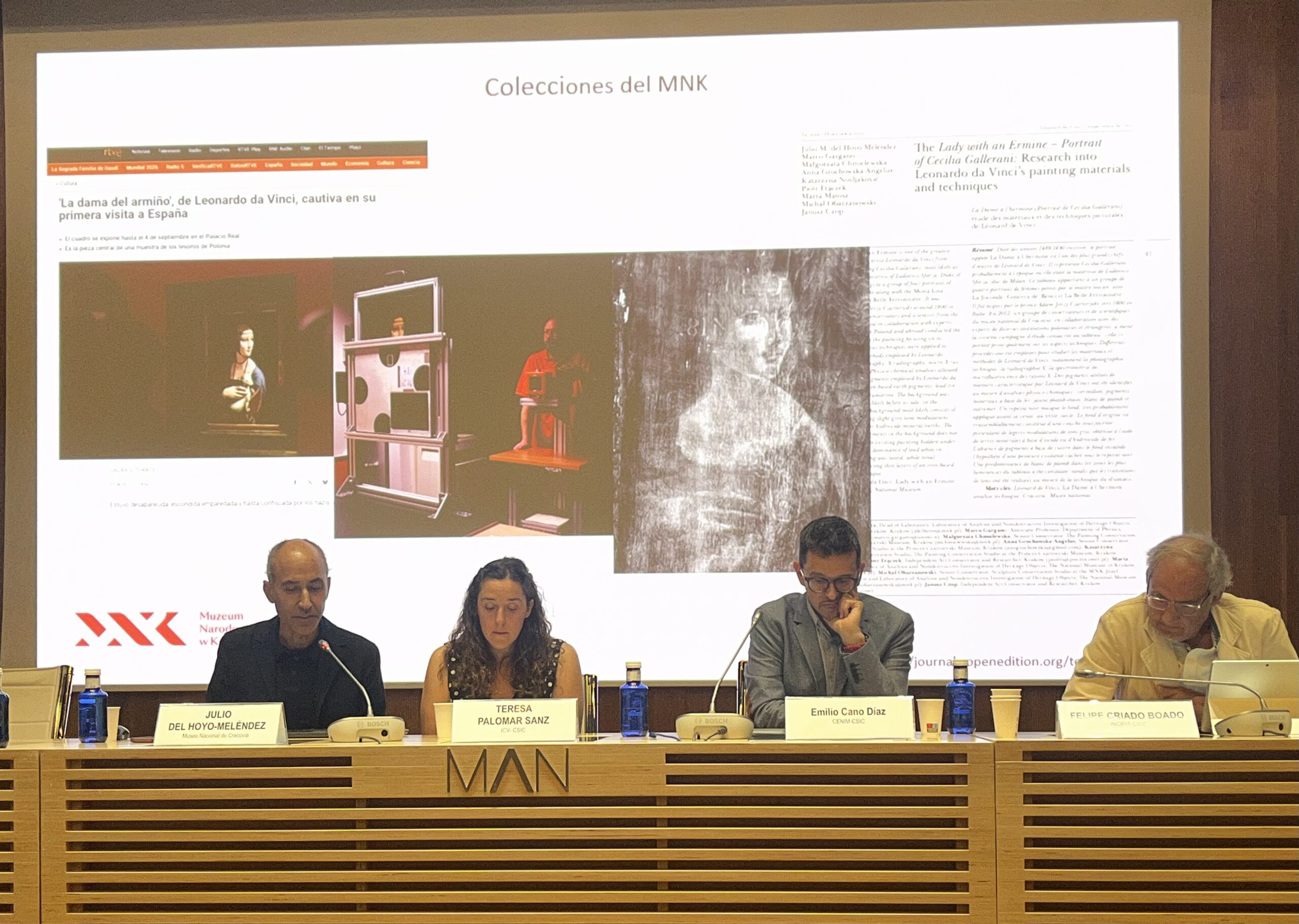
Panel on the future of heritage science at “Misterios de la materia” (MAN, Madrid). From left: Julio del Hoyo-Meléndez (Muzeum Narodowe w Krakowie), E-RIHS SEAB Chair; Teresa Palomar Sanz (ICV-CSIC); Emilio Cano Díaz (CENIM-CSIC), Spanish National Node Coordinator and vice-chair of the Committee of National Nodes of E-RIHS; and Felipe Criado Boado (INCIPIT-CSIC). Credits: Vania Virgili
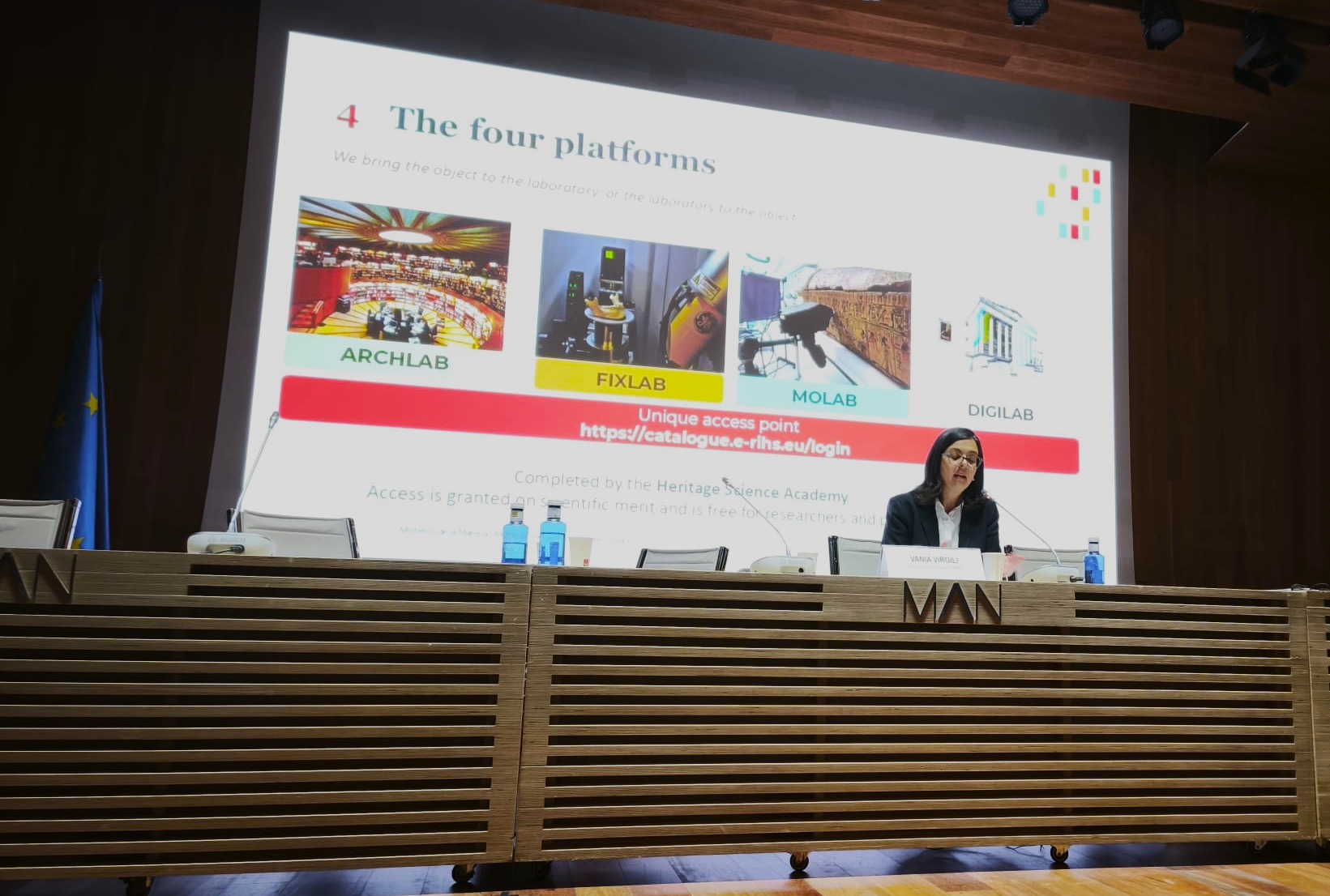
E-RIHS Director General, Vania Virgili during her presentation on June 11th, Madrid. Credits: Emilio Cano
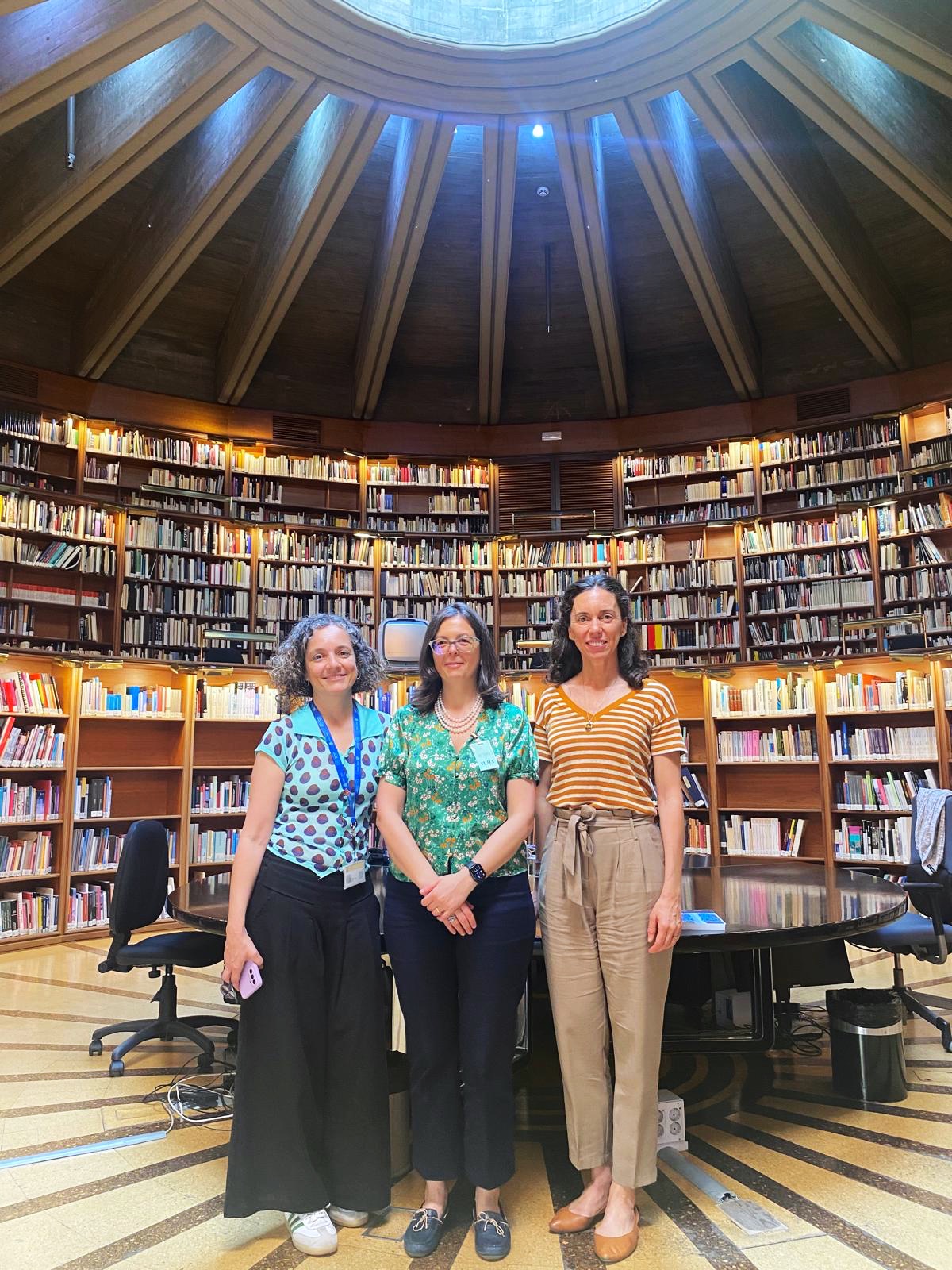
From left: Marisa Sánchez Gómez, assistant Deputy Director General of the Spanish Cultural Heritage Institute (IPCE), Vania Virgili, E-RIHS Director General, María Martín Gil, Head of the department of Research and Training of IPCE during a visit to the IPCE Library. Credits: IPCE
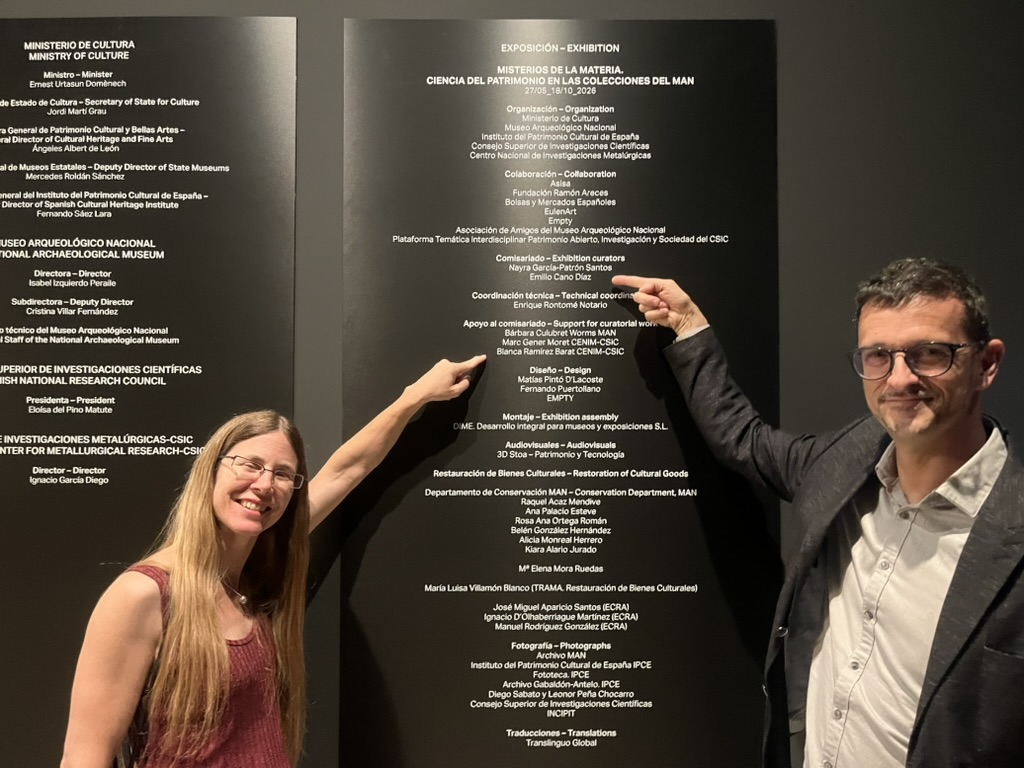
Emilio Cano, exhibition curator and E-RIHS Spanish National Node Coordinator, and Blanca Ramírez Barat, curatorial support, both CENIM-CSIC, at the credits wall of “Misterios de la materia”. MAN, Madrid. Credits: Vania Virgili
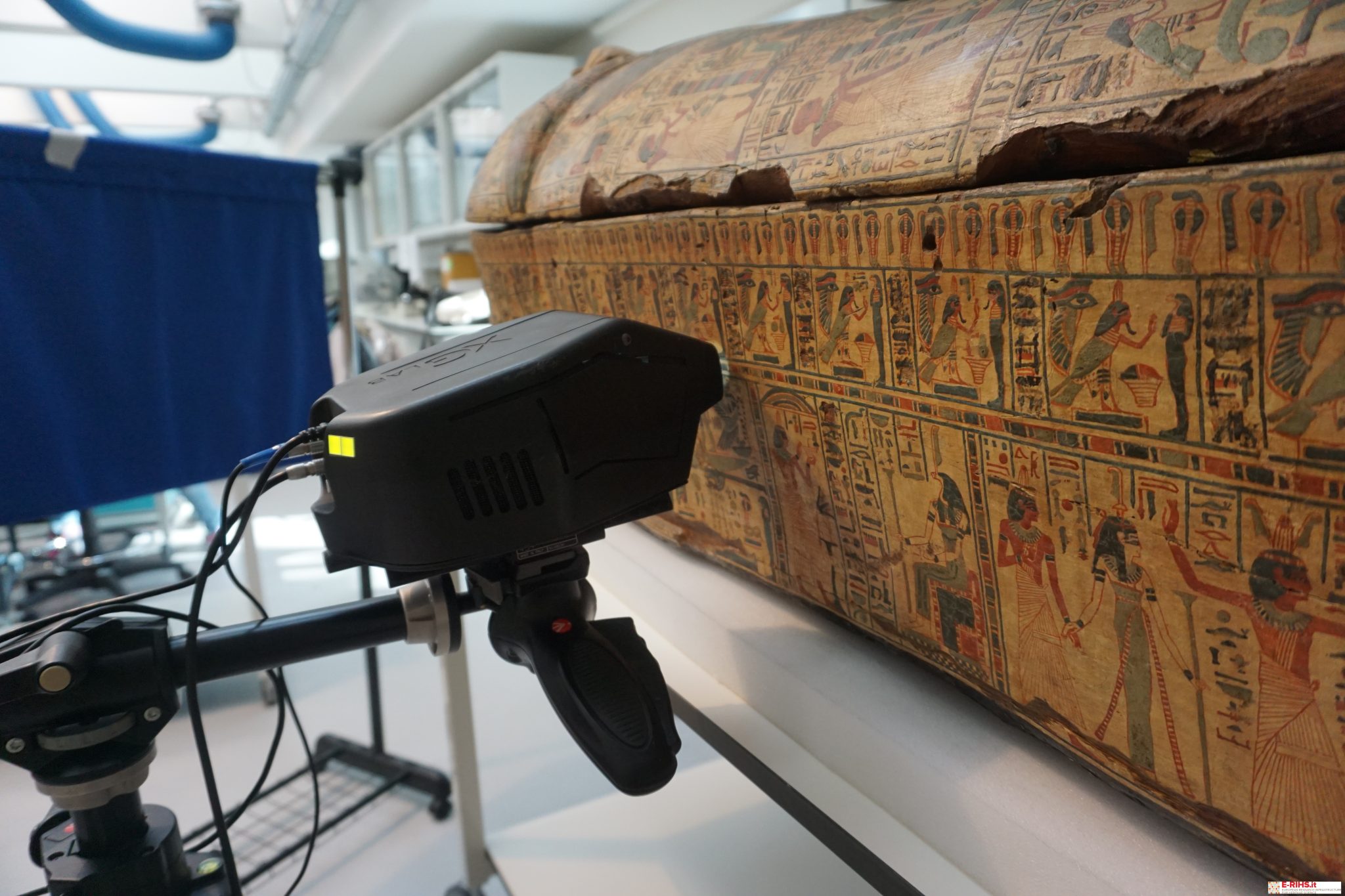
Peman project – MOLAB CNR Scitec in Perugia
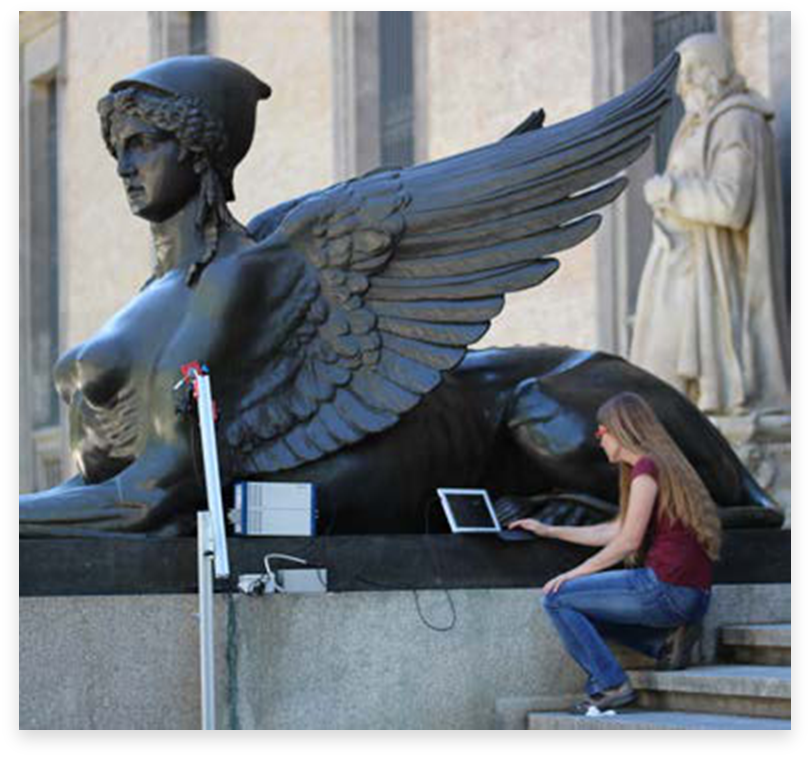
Blanca Ramírez Barat (CENIM-CSIC) during in-situ measurement on one of the MAN sphinxes.