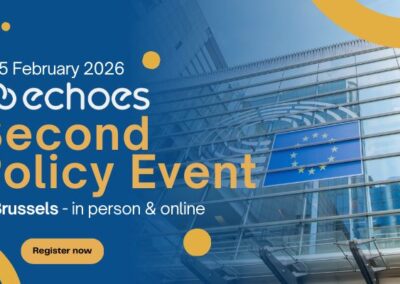
On February 26th, 2026, join the Green Conservation for Cultural Heritage and Sustainable Policy Instruments meeting: a full day of talks and discussion with leading heritage scientists, innovators, and conservators online from 9:30 to 18:30 CET. E-RIHS ERIC will participate with a speech by the director general, Vania Virgili, during the “Discussion on Policy Measures for Green Conservation at the EU level” panel. In this session, the discussion will focus on future vision, translation to practice & industry, barriers & gaps, support structures & policy instruments.
You can find the full programme and further information can be found here. The morning programme will highlight recent advances in green conservation for cultural heritage. By opening the discussion to a broader community, the session aims to strengthen dialogue among researchers, practitioners, policy makers, and industry, positioning Europe as a global leader in sustainable heritage innovation. In the afternoon, Round Table III will bring together experts to explore how green conservation goals can be integrated into policy. This strategic policy meeting brings together Green Cluster Project participants, European Commission policymakers, and leading practitioners in conservation, cultural heritage, sustainability, and industrial stakeholders to explore how green conservation can be more effectively integrated into European cultural heritage policy.
The event is presented by the Green Cluster for Science and Conservation Research, the Horizon Europe RIA cluster of GoGreen, MOXY, and GreenArt projects: a unique collaboration of researchers, scientists, conservators, and educators advancing greener materials, methods, and policies in heritage conservation.
Though independently led, these three projects are united by a shared goal—to develop and promote sustainable, environmentally responsible conservation materials, decisions and practices. Green conservation is not only an environmental and social responsibility; it also requires a strong scientific foundation to ensure interventions are effective, safe for materials and operators, and sustainable over time.
Hosted at the Koninklijk Instituut voor het Kunstpatrimonium / Institut Royal du Patrimoine Artistique (KIK-IRPA), the meeting is open online to all interested stakeholders, ensuring broad accessibility across Europe and beyond (registration is free and required – Deadline for subscription: 18/02/2026).